For many visa-free visitors, Armenia’s general limit is 180 days during one year, unless an international agreement sets another period. That is the rule in Article 7 of the Law on Foreigners. It is not a universal allowance for every passport, and it does not say that every new arrival automatically starts another allowance.
Someone travelling on a paid visitor visa needs to read the duration on that visa. Someone with Armenian residence or a qualifying employment-based document needs to read that status instead. Start by identifying the rule, then count the days that matter to it.
TL;DR
- The MFA’s general rule is 180 days during one year for visa-free visitors, subject to treaty exceptions. It does not mean six calendar months for every traveller.
- Treaties can set a different limit: the China agreement and Iran agreement each specify 90 days within a 180-day period for their covered travellers.
- Keep every entry and exit, including earlier trips and trips made with an old passport. The worked examples below use inclusive dates for cautious planning; that is an editorial assumption, not a published border algorithm.
- A short exit does not establish an automatic reset under the general yearly rule. Plan longer residence around a real eligibility ground rather than a stamp alone.
- Visitor-visa extensions and residence applications are different procedures. Changes announced for 1 November 2026 affect residence applications and fees; they are labelled separately below.
Sources reviewed on 22 October 2026. This is a researched editorial guide without a named legal reviewer. It explains the published rules and arithmetic, but cannot certify your personal final lawful day or resolve a disputed status.
Which limit applies to your visit?
Choose your basis before using a calculator. “Visa-free”, “visitor visa” and “residence card” describe different positions. Your reading language does not decide which one applies.
Table caption: Stay categories checked against Armenian law, MFA guidance and the linked treaties on 22 October 2026. The actual document and any applicable agreement control the individual case.| Basis for being in Armenia | Starting rule | What to check next |
|---|---|---|
| Nationality-based visa exemption with no different treaty period | General maximum of 180 days during one year | All visits in the relevant period and any other applicable conditions |
| Temporary foreign-residence-permit exemption | MFA scheme allows up to 180 days within a one-year period | The conditions and dates of that temporary scheme, not a permanent residence right |
| Chinese ordinary passport covered by the bilateral agreement | Up to 90 days within a 180-day period | Covered activities and the agreement’s requirement for advance visa arrangements for work, study or longer residence |
| Iranian traveller covered by the bilateral agreement | Up to 90 days within any 180-day period | Any authorised extension under Armenian law |
| Issued visitor visa | The authorised stay and validity on the visa | Entries allowed, expiry and any approved extension |
| Armenian residence status or qualifying employment-based document | The conditions and period of that status | Validity, renewal and the evidence confirming it |
The temporary exemption PDF states the scheme’s period as 1 July 2026 to 1 July 2027. Its closing date is not a licence to ignore your own accumulated days, and it is not by itself a statement about every stay extending beyond that date. The entry guide explains the passport and foreign-residence-document tests.
How do you count the days in a visit?
For the examples here, count both the arrival and departure dates: departure date minus arrival date, plus one. This deliberately avoids understating the trip by omitting its boundary dates. We did not find an explicit official general algorithm confirming that exact endpoint treatment, so these are planning counts, not official border-system results.
Use dates rather than “about three months”. Calendar months have different lengths, and the legal limit is expressed in days. Keep the arithmetic separate from the question of which year or other window applies.
One continuous visit
Suppose you enter on 10 January 2026 and leave on 8 July 2026, with no earlier trips affecting the example. The inclusive count reaches 180 days:
Table caption: Hypothetical continuous trip. Original editorial calculation with both entry and exit dates included; no personal legal deadline is certified.| Part of the trip | Days | Running count |
|---|---|---|
| 10 to 31 January | 22 | 22 |
| February | 28 | 50 |
| March | 31 | 81 |
| April | 30 | 111 |
| May | 31 | 142 |
| June | 30 | 172 |
| 1 to 8 July | 8 | 180 |
Leaving on 9 July would make the same planning count 181. This demonstrates the arithmetic. Whether 180 is the right allowance for you must already have been established from your nationality, documents and applicable agreement.
Several visits in the same history
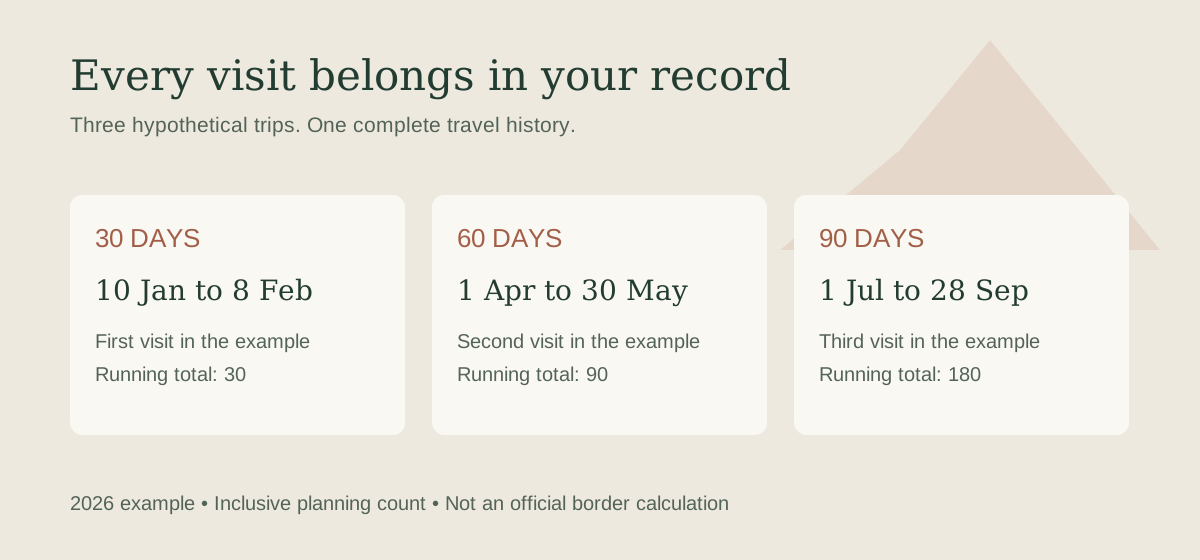
Now suppose the traveller makes three separate trips. The days abroad between visits are not added to the days spent in Armenia.
Table caption: Hypothetical repeated visits in 2026. These are counted days in the illustrated history; applying a legal allowance still requires the correct reference period.| Visit | Inclusive days | Total in this history |
|---|---|---|
| 10 January to 8 February | 30 | 30 |
| 1 April to 30 May | 60 | 90 |
| 1 July to 28 September | 90 | 180 |
The sum is 30 + 60 + 90 = 180. Looking only at the July arrival would discard the earlier 90 days from your own record. A new passport number does not demonstrate that those earlier visits have stopped being relevant.
A useful travel ledger has one row per visit: entry date, exit date, travel document used, the basis for that stay, counted days and the evidence you kept. If two records refer to the same boundary day, avoid counting the same day twice when building a combined history. Missing stamps or an uncertain crossing date call for an official record or clarification, not a guessed total.
Is the general “one year” a calendar year or a rolling year?
The reviewed text of Article 7 says “during one year”. The general MFA visa page does not publish a full calendar-year or rolling-year calculation method. We therefore cannot present either a 1 January reset or a particular rolling calculator as an officially confirmed general rule.
Here is why that gap matters. Consider two hypothetical trips, counted inclusively:
- 1 October to 29 December 2026: 90 days.
- 1 January to 31 March 2027: another 90 days.
A column restricted to calendar year 2027 contains 90 days by the end of March. A period covering both trips contains 180. On 1 April 2027, those columns would show 91 and 181 respectively. Both calculations are arithmetically correct; the reference period differs.
Do not choose the more favourable column and treat it as permission. For repeated visits near the limit or a trip crossing the year boundary, send the full history to the competent authority and ask which period applies. The request template below makes that question specific. Treaty wording such as 90 days in a 180-day period is a separate rule, not proof of the algorithm for the general 180-day yearly allowance.
Does a weekend in Georgia reset your stay?
The general yearly rule does not grant an automatic reset for a short exit. A new stamp records a crossing; it does not itself replace the published allowance. That is why this guide does not turn a successful border crossing reported online into a guaranteed long-term plan.
The Google results we reviewed included conflicting accounts of people crossing into Georgia and returning. Some described visa purchases, some visa-free travel and some nationality-specific registration arrangements. Those are materially different situations. A story about another person’s admission cannot establish your own status or erase earlier days.
If you want to remain for a longer period, identify a lawful route before the current permission ends. Also avoid the opposite unsupported claim that everyone must spend exactly six months outside Armenia. The applicable rule and documented history must support that conclusion too.
Can you extend a visitor visa inside Armenia?
Yes, subject to the applicable rules and a decision on your application. Armenian law, Article 9, provides for visitor-visa stays of up to 120 days, with possible extension by up to 60 days. The maximum is not an automatic grant, and your issued visa may be shorter.
The Migration and Citizenship Service’s extension page gives this process as of the review date:
- Apply before the issued visa expires at 14 Tairov Street, Yerevan, in person or through an authorised representative. The page says an online appointment is not required for this service.
- Submit the extension application and explain why you need the additional stay.
- Provide the passport, one colour photo measuring 35 × 45 mm, and evidence of payment of the applicable fee.
- Keep the approved extension and its exact dates. The service page states that extension takes place on the application day, but do not postpone a deadline on the assumption that your case will have no complication.
The published fee is 500 AMD for each extension day. A hypothetical approved 30-day extension costs 15,000 AMD; 60 days costs 30,000 AMD, if the fee applies. These are multiplication examples, not quotes for residence cards. The department lists exemptions, including minors and certain close relatives, students and other specified categories; eligibility for an exemption needs its own evidence.
This is a visa-extension procedure. Do not assume that a visa-free visitor can purchase another 60 days through the same route. Ask about the appropriate basis for that situation instead.
What are the main routes to staying longer?
Study, qualifying employment, genuine business activity and specified family relationships can provide residence grounds. The MFA residence overview sets out the current eligibility categories. Paying rent or having savings is not, by itself, one of the listed general grounds.
Table caption: Longer-stay routes and the evidence that makes each relevant. This is an initial choice of basis, not a complete residence-application tutorial.| Situation | Route worth assessing | Evidence that matters |
|---|---|---|
| Accepted for study in Armenia | Study-based temporary residence | The actual institution and admission or study documents |
| Hired for qualifying work in Armenia | Employment-based process | Employer, contract and the applicable work-permission or exemption route |
| EAEU citizen employed by an Armenian-registered company | Certificate of legality of residence route | Citizenship, signed employment contract and the official certificate procedure |
| Eligible family connection | Residence under the relevant family category | Relationship and the sponsor’s citizenship or qualifying status |
| Genuine entrepreneurial activity | Business-related residence | Evidence of the business and the requirements for the application date |
| Armenian origin or an existing Armenian status | The specific applicable residence route | Documentary basis and the transition rules for that status |
As of 22 October, the MFA lists temporary residence cards for up to one year, with renewal possibilities. This does not mean everyone can obtain one simply by wanting to remain for a year. The application must fit a recognised ground.
For EAEU workers, the official Hartak certificate page requires employment with an Armenian-registered company. It describes the signed contract, passport copy and photo among the required evidence. A visitor working remotely for an overseas client should not assume that this is the same case. Under the current Article 7(3), the covered worker who intends to exceed the general allowance must apply for the certificate before that allowance expires.
Address registration and immigration permission also need to be distinguished. Do not treat a lease, a registration appointment or a social-services number as an automatic residence grant for every nationality. Treaty-specific arrangements can matter, including for Russian citizens, but they must not be generalised to every English-speaking visitor. If your stay depends on such an arrangement, identify the exact status and obtain confirmation for your document.
What changes on 1 November 2026?
The announced residence changes are future rules at this guide’s 22 October review date. They affect how you plan an application that falls around the changeover. They do not create extra visa-free days simply because a reform is coming.
Hartak’s notice dated 9 October announces the following standard fees from 1 November 2026:
Table caption: Published standard fees and announced changes, not a personal payment quotation. Nationality-based exceptions and the application’s transition position need separate confirmation.| Service | Standard rate before the announced change | Announced rate from 1 November |
|---|---|---|
| Temporary residence | 105,000 AMD | 150,000 AMD |
| Permanent residence | 140,000 AMD | 250,000 AMD |
| Certificate of legality of residence | Free | 30,000 AMD |
The notice also says the residence application fee will not be refundable following refusal from that date. The current MFA overview lists separate reciprocal fees for US citizens, so the standard-rate table should not be read as resolving every individual exception.
The Migration and Citizenship Service’s June notice says residence applications move to a new electronic system on 1 November, and the existing migration.e-gov.am and Early One residence services become unavailable for that process. It explicitly addresses people with appointments after that date. A previously booked slot is not the same as a submitted application.
The amending law HO-11-N, Articles 10 and 30, distinguishes pending proceedings from an appointment or saved form. It provides that applications submitted before entry into force are examined under the earlier rules, and introduces lawful stay during qualifying residence proceedings when the previous stay or residence period expires. Do not treat an unsubmitted draft as such a proceeding, or assume it creates protection before the new rule applies.
For the workers covered by its certificate provision, the amending law also requires applying immediately after concluding the employment or services contract. That is a change from treating the end of the general allowance as the only deadline to watch.
The same law preserves existing special-residence rights until their expiry, rather than cancelling every existing special passport on the changeover date. It also makes the new work-visa provisions dependent on the launch of the new electronic visa system. We have not tested that future service and do not describe it as already available.
For a deadline around the transition, retain evidence of what was actually submitted and when, and obtain an answer on which rules cover that submission. This is more useful than rushing to pay an older fee or assuming that booking an appointment preserves the previous process.
How do you ask for a clear answer about your own deadline?
Give the authority the complete history and the documents that establish your basis. A useful enquiry is short enough to answer, but specific enough to avoid a reply that merely repeats the general yearly limit.
You can adapt this text for the Migration and Citizenship Service:
I am a citizen of [country] travelling on [document type]. My entries and exits are [each date pair]. My current visa or residence basis is [document and validity, or visa-free basis]. I plan to remain until [date].
Please confirm which reference period applies to my stay, how entry and departure dates are counted, and the last permitted date under this history. If I apply for [specific route], please confirm what establishes the start of proceedings, whether my stay remains lawful while it is considered, and which transition rules apply.
This is an editorial template, not an official form. Use the authority’s own channel for any identity information it requests. Keep its written answer with the dates and application records. A generic verbal comment about another traveller is weaker evidence than an answer addressing your own history.
Quick answers about staying longer
Is 180 days the same as six months?
No. Count dates rather than replacing a day limit with calendar months. In our inclusive example, 10 January to 8 July 2026 contains 180 days; the legal allowance and counting method still need to match your case.
Can a 120-day visa simply become 180 days?
Only an approved extension can change its authorised stay. The general possibility of up to 60 extra days is not an automatic addition to the document you received. Apply before expiry through the appropriate procedure.
Does 1 January automatically reset the general allowance?
The reviewed general law and MFA page do not explicitly publish that reset. The cross-year example shows why different reference windows produce different results. Get confirmation before relying on the more generous calculation.
Does getting an address or social number settle my immigration status?
Not automatically for every visitor. Those documents serve different purposes, and citizenship-specific arrangements must be assessed separately. Establish which document or official record proves the status you intend to rely on.
What if an appointment is later than my current permission?
An appointment by itself is not a residence grant or proof that proceedings have begun. Establish the submission route and any applicable lawful-stay rule before the existing permission ends. Around November’s changeover, record whether you merely booked or actually submitted the application.
Can I just pay an overstay fine and remain?
A fine is not a residence permit or an extension. If your permission has expired or your records are disputed, contact the competent authority promptly and obtain qualified advice for the actual case. This guide does not quote a universal penalty or promise that paying one settles future admission.
Sources and limits of the guide
The factual basis is the Law on Foreigners, the China and Iran agreements, MFA visa and residence information, the Migration and Citizenship Service’s extension procedure, Hartak’s fee notice and HO-11-N’s transition provisions. The tables of trip dates and cost multiplications are our own labelled examples.
The unresolved general year-window and endpoint questions prevent us from offering an official universal deadline calculator. They do not prevent you from keeping an accurate history, identifying the correct rule and preparing a longer-stay basis early. For entry documents, children and foreign residence permits, return to the entry-requirements guide. For the practical cost of remaining, use the separate monthly-budget guide.