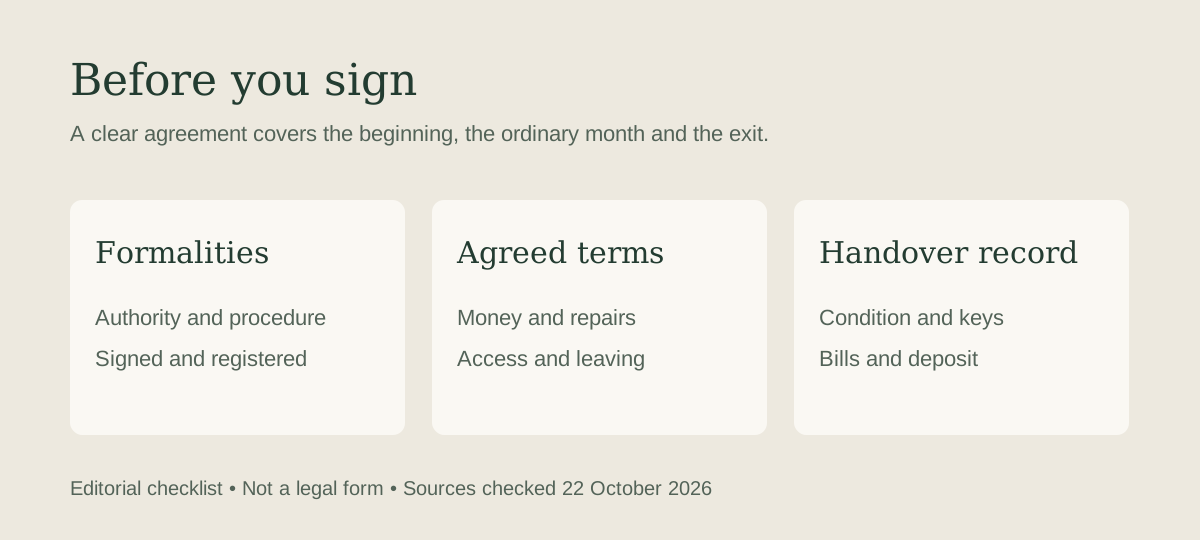
You have chosen the apartment. Before you pay, make sure the rental agreement answers the questions that will matter after moving in: can the rent change, who pays when something breaks, and what happens to the deposit when you leave?
In Armenia, the paperwork needs a separate check too. A residential lease has formal requirements, and the official standard-form route is more specific than downloading a template and signing it at home. Start with the signing procedure, then work through the money and the end of the tenancy.
TL;DR
- Civil Code Articles 662 and 663 require a written signed residential lease, notarial certification and registration of the rights arising from it. Article 299 provides a specific exception for approved model forms and prescribed signature verification.
- The Cadastre’s official instructions describe that model-form procedure. A generic internet template does not automatically qualify.
- Confirm who owns the property, who is authorised to sign and who may receive each payment. A viewing agent and an authorised payee are not necessarily the same person.
- Separate rent, advance rent, the refundable security payment and the agent’s fee. Agree the evidence and timing for deductions before handing over the deposit.
- For the tenant’s statutory termination route, Article 675 specifies three months’ written notice, with the agreement of the other permanent occupants. Do not mistake a familiar one-month arrangement for a universal rule.
This guide concerns a residential apartment already selected, irrespective of the tenant’s nationality. Searching listings and comparing viewing options belong in the apartment-search guide. Sources were checked on 22 October 2026; the proposed clauses below are editorial examples for professional review, not legal advice on a particular agreement.
Do you need a notary and registration?
The general residential-lease rule is a single written document signed by the parties, with notarial certification and registration of the resulting rights. Read Articles 662 and 663 alongside Article 299, which defines the approved-form exception. Saying that notarisation is simply optional misses that distinction.
Article 299’s exception requires the terms to follow the government-approved model form, contain no other conditions and have the signatures recognised through the prescribed process. An agreement does not become an approved model merely because an agent calls it “standard”.
Table caption: Two formalisation routes described by Civil Code Article 299, Articles 662 and 663, and the Cadastre’s model-form instructions. Confirm the route for the complete text you intend to sign.| Route | What makes it different? | What to settle before payment |
|---|---|---|
| Individual residential agreement | The general notarial route applies | Final wording, translation arrangements, signing, registration and who pays each cost |
| Approved model form with prescribed signature verification | A specific exception to notarisation, subject to its conditions | That the complete agreement fits the approved form and that the signature-verification procedure is completed |
| A private template signed at home | That action alone does not establish either completed route | Obtain advice on formalising it rather than treating the printout as finished paperwork |
The official contract catalogue says the parties must attend a Cadastre service office in person to sign through its described model-form procedure. It includes a Residential Area Lease Agreement. Do not select a similarly named lifetime rent, permanent rent or use-right agreement just because the English title contains “rent” or “residential”.
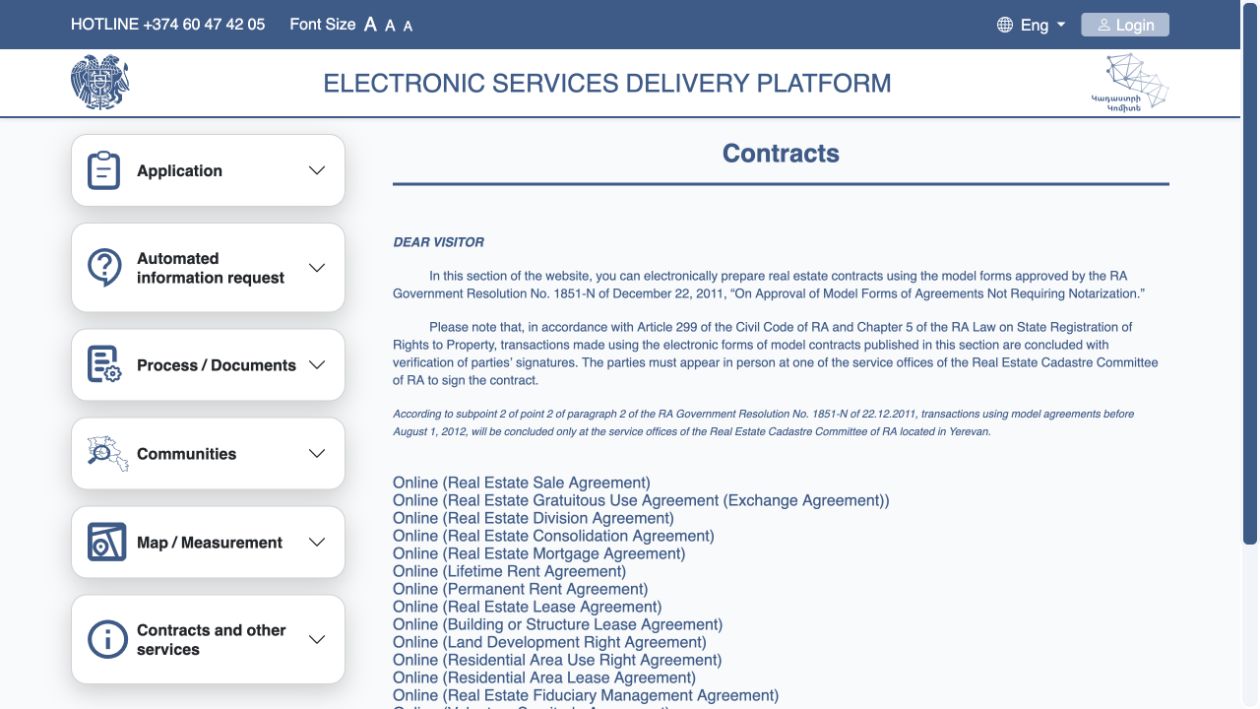
Official Cadastre portal, captured 22 October 2026. The screenshot preserves the instructions as observed. Open it for a larger view; no application was submitted.
Can you add your own deposit and repair clauses to the model?
Do not assume that you can add any clause while keeping the same exception. Show the complete proposal, including appendices, to the notary or Cadastre before deciding how to sign it.
The official residential form already has fields covering rent, term, repair responsibilities and certain other choices. Its additional-notes field is restricted to information from the registration certificate’s additional-notes section. It is not an unrestricted box for every privately negotiated condition.
If you need more detailed deposit, access or early-exit arrangements, resolve their wording and the appropriate formalisation route together. Agreeing something useful is only half the task if you then sign it through the wrong procedure.
What happens after signing?
Decide who will arrange registration and give you the result. Cadastre registration guidance describes applications through service offices or e-cadastre, with an electronic signature for online submission, and the registration certificate issued after completion.
The official FAQ says rights arising from notarised real-estate transactions must be registered within 30 working days of notarisation. That is not a promise that processing takes 30 days. Agree who submits promptly, follows any requests and retains the result.
The same FAQ distinguishes free conclusion of contracts at Cadastre offices from chargeable registration services and state duty. Ask for the cost breakdown for your chosen procedure, including any notary and translation work. This guide does not invent one all-inclusive fee.
Who should sign the agreement and receive your money?
Article 660 identifies the lessor as the owner or a person authorised by the owner. Match the property details, ownership evidence and signatory before transferring money.
Check the full address and apartment number. If you rent only part of a property, the agreement should identify that part. If a representative signs, establish the authority for the actual transaction, including receiving the rent or deposit. A family relationship to the owner is not a substitute for that evidence.
Example: the owner signs the lease but asks you to transfer the deposit to a brother’s account. Before paying, obtain a documented explanation of the recipient’s authority and how that payment discharges your obligation under the agreement. The record should also leave no doubt about who must return the security payment.
Use the Cadastre’s property information and document-checking services for property evidence. Its FAQ says any person can apply for the unified certificate and gives its validity as 15 days. That is a reason to examine the scope and date of the document, not to treat an old ownership photograph as current confirmation of every restriction.
How should you separate rent, deposit and other payments?
Give each payment an amount, purpose, recipient and record. A total described only as “money for the apartment” leaves the eventual settlement open to argument.
The following is an illustrative payment breakdown, not a surveyed price or a mandatory deposit size:
Table caption: Hypothetical signing payments for a 260,000 AMD monthly rent. The commission and deposit are assumed for the example, not requirements imposed by Armenian law.| Payment | Example amount | What the agreement should explain |
|---|---|---|
| Rent for the first specified month | 260,000 AMD | Which dates it covers and when the next payment falls due |
| Refundable security payment | 260,000 AMD | What it secures, permitted deductions and the agreed return procedure |
| Agent’s fee | 130,000 AMD | Separate service, recipient and when it is earned |
| Total of these three payments | 650,000 AMD | This subtotal excludes registration, translation and utilities |
A payment description can identify the purpose, the property and the agreement date: for example, “Rent for [period] under the residential lease dated [date], [address]”. Use a separate description for the security payment. These are practical recordkeeping examples, not statutory wording.
For cash, obtain a signed receipt identifying the payer, recipient, amount, date and purpose. A bank transfer also needs a clear purpose and the correct recipient; the mere existence of a transfer does not explain every term of the lease.
What should the deposit clause actually say?
It should explain what can be deducted, what evidence supports a deduction, when the balance is returned and what happens if the last utility bill arrives later. Agree this while both sides still have a reason to finish the deal.
Here is an example of the points to put into a professionally reviewed clause:
The security payment is 260,000 AMD. The agreement identifies the obligations it secures and the evidence required for deductions. The parties record the property’s condition at handover and return. The balance is returned within the agreed seven-day period after return, subject to any specifically agreed reserve for bills not yet issued. An itemised statement accompanies deductions.
The amount and seven-day period are editorial proposals, not an official minimum, maximum or deadline. A complete clause also needs to say how damage, ordinary wear, missing items and disputed claims will be handled. Do not leave those distinctions inside the phrase “if everything is fine”.
What would a final calculation look like?
Suppose both sides agree that 18,500 AMD of utilities remain unpaid and accept evidence of 12,000 AMD of tenant-caused damage. With the example deposit:
260,000 - 18,500 - 12,000 = 229,500 AMD to return.
This is a hypothetical calculation, not a decision that either deduction would be justified in your case. The statement should name each bill or item, its amount and its evidence. If the owner instead claims 50,000 AMD without explaining what it covers, ask for the itemised basis rather than accepting a new total as self-explanatory.
If the final gas bill is still missing, define any agreed reserve separately. For example, retaining an agreed 10,000 AMD reserve from the 229,500 AMD balance means 219,500 AMD paid now, with the remaining reserve settled according to the agreed bill-and-deadline procedure. That example is not permission for an indefinite hold on the whole deposit.
Do not silently use the deposit as the last month’s rent. Agree any offset explicitly, including what remains available to cover other obligations and when the remaining balance will be settled.
Can the landlord increase the rent during the term?
Article 671 says the parties agree the rent and prohibits unilateral changes except where the law or contract provides otherwise. It also makes payment monthly unless the agreement specifies a different arrangement. Read the rent-change clause before accepting a fixed monthly figure as fixed for the whole tenancy.
A proposal for discussion might say: “The monthly rent is 260,000 AMD for the agreed fixed term; any change requires an appropriately formalised agreement between the parties.” Have the actual wording checked within the complete contract. This is not a claim that every rent-change clause is unlawful.
If the draft references another currency, make the calculation method and payment amount understandable. Rather than leaving “at today’s rate” unexplained, settle which date and published rate the parties intend to use and have the payment arrangement reviewed. The monthly-budget guide explains how a chosen rent affects your household costs; it does not decide the contract’s currency terms.
Who pays when something breaks?
Article 670 assigns routine repair to the tenant and major repair to the landlord unless the contract provides otherwise. That qualification matters: read the agreed allocation instead of relying on a slogan that all repairs belong to one side.
An appliance fault needs facts. A fridge that stops cooling after ordinary use is not the same situation as a damaged door recorded after an accident. Neither the word “repair” nor the landlord’s ownership automatically decides the bill for every appliance.
Agree a workable process: who receives the report, who arranges inspection, who approves the work, and what happens if urgent action is needed. Record known defects at the start. For example, a note saying “washing machine leaks at the inlet connection” is more useful later than “appliances in satisfactory condition”.
Avoid authorising a vague rule that you pay whatever repair or replacement the owner chooses. The procedure should make the cause, required work and agreed responsibility visible before the final deduction is made.
When may the landlord enter the apartment?
Set a process for ordinary visits and a separate one for emergencies. A spare key does not answer when an inspection happens, who attends or how you are told.
An illustrative arrangement is to agree routine inspections or repairs at least 24 hours in advance, for a time both sides accept. The 24-hour period is a negotiation example, not a universal legal notice period established by this guide. Emergency access needs its own description, including contact attempts and a record of what happened.
Put the usable contact details and communication method in the agreement. “I will come when necessary” leaves too much unclear, especially if you work from home or travel frequently.
How can you leave early and finish the payments?
Read the exit clause before signing, even if you expect to stay for the full term. Article 675 provides a tenant termination route with the agreement of the other permanent occupants and three months’ written notice to the landlord. An informal “just give me a month” is not the statutory rule described there.
If both parties agree an earlier end, document the actual agreement and have its form checked. It should settle the release date, return of keys, last rent date, unused advance payments, deposit calculation and bills still to arrive. Finding a replacement tenant or dropping off the keys does not, by itself, show that all obligations have ended.
For the notice itself, agree the recipient, address or other properly reviewed delivery method, and how receipt is evidenced. A message saying “I am leaving soon” is much less useful than a dated notice that identifies the lease and the proposed end.
Articles 675 and 676 describe judicial termination on the specified grounds and eviction based on a court judgment. Do not accept a blanket “immediate eviction for any breach” clause without legal review. Equally, this guide cannot decide whether a particular missed payment, dispute or possession claim satisfies those grounds.
What should the handover record contain?
It should let both parties compare the apartment at the beginning and end. Keep the inventory and condition record with the lease, rather than relying on a photo gallery that neither side has identified or acknowledged.
Record the furniture and appliances actually handed over, specific existing damage, meter readings and the number of keys. Link photos to identifiable rooms or items and agree how they form part of the record. “Chip on the right corner of the kitchen worktop” is a usable description; “used kitchen” is not much help in a deposit dispute.
At return, record the keys, readings, condition and agreed outstanding amounts again. Do not sign an unconditional “no claims” statement while an agreed payment or documented issue remains unresolved. If a point is disputed, record that fact without pretending the dispute has been settled.
Keep copies of:
- The final signed lease and appendices, together with registration evidence.
- Any representative’s authority and the agreed payment-recipient information.
- Receipts and transfers, organised by period and purpose.
- Changes, notices, the final return record and the deposit statement.
What if the apartment is sold?
Article 664 says transfer of ownership is not itself a ground to terminate or change the residential lease, unless otherwise provided by law. It makes the new owner the landlord under the previously agreed conditions.
That is not a reason to send money to any new account announced by a stranger. Confirm the ownership change and the correct recipient, then keep the documented instructions with the agreement. The general rule does not decide a dispute about the actual transaction or documents.
Questions to settle before signing
Is an English template signed at home enough?
Do not assume it completes the formalities. Determine which of the two official routes fits the full agreement and complete the relevant signing and registration process. The language of a printout does not establish that process.
Can I sign the official form without understanding Armenian?
Get an understandable translation before signing and arrange the language assistance required for the chosen procedure. Even the English-interface residential form has an Armenian body. Ask how the final versions and any differences will be handled; an agent’s oral summary is not a substitute for reading your obligations.
Does the deposit have to equal one month’s rent?
That is the amount chosen in our example, not a legal requirement established here. State the actual agreed sum and its function separately from advance rent. The conditions for return matter just as much as the amount.
Does signing a lease extend my permission to stay in Armenia?
Do not treat housing rights and immigration permission as the same document. The appropriate basis depends on your circumstances and applicable rules. Use the separate length-of-stay guide for that question.
What should I do if the deposit is not returned?
Request an itemised calculation and supporting evidence, and preserve the lease, payment records, condition photos and return record. If you cannot resolve the disagreement, seek advice based on that complete file. This guide cannot determine liability or promise recovery of a disputed sum.
Can I copy these examples into my agreement?
Use them to identify the decisions that need wording, then have the complete draft checked. They are not a finished legal template, and additions may affect whether the approved standard-form procedure is suitable. No individual contract or qualified legal review is claimed here.
Sources and the next step
The principal sources are the official Russian Civil Code translation published 7 October 2026, its residential-lease and formalisation provisions, the Cadastre catalogue, residential form, registration guidance and FAQ. The Russian translation was checked alongside an older official English translation; the money and notice examples above are expressly editorial proposals.
Bring the final draft, appendices and proposed payment breakdown to the person handling the formalisation. Resolve the outstanding terms before paying on the assumption that they will be added later. If you are still comparing properties rather than preparing a lease, return to the rental-search guide or the district comparison.